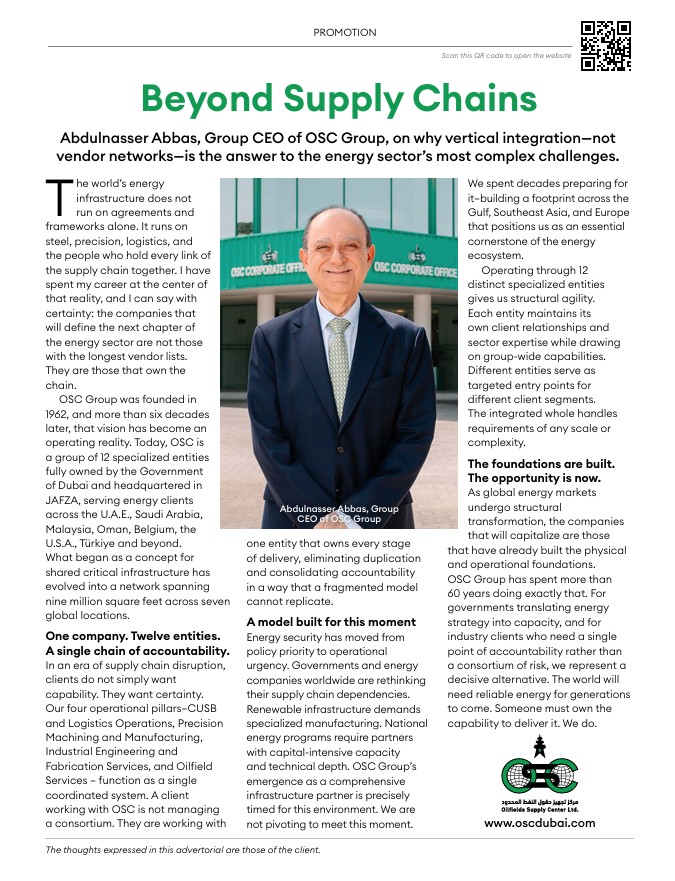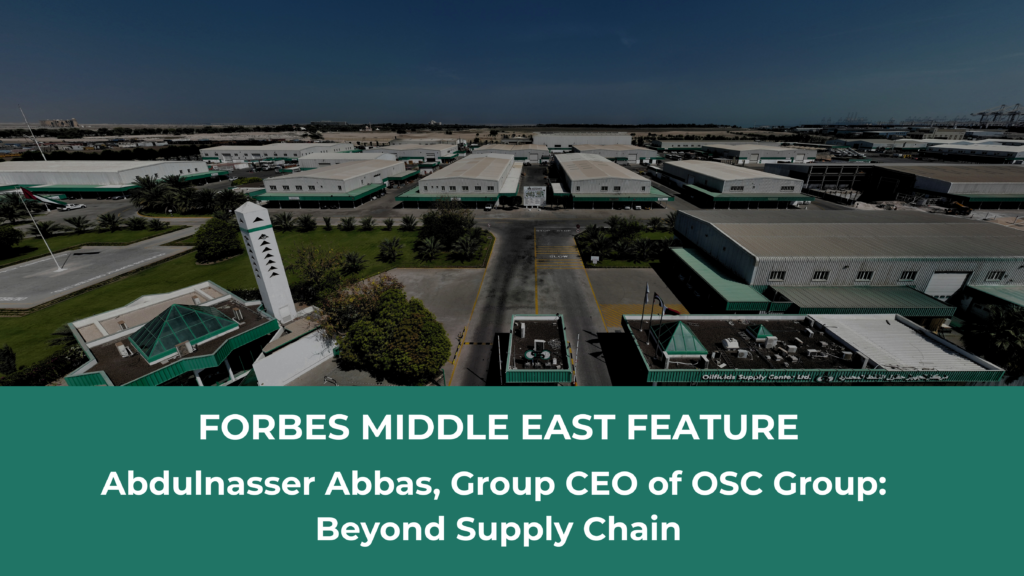
Forbes Middle East Feature: Why Owning the Chain Matters
In a recent Forbes Middle East feature, OSC Group CEO Abdulnasser Abbas articulates a clear distinction: the companies that will lead the energy sector are not those with the longest vendor networks, but those that own the entire operational chain. As global energy markets undergo structural transformation driven by shifting government priorities and renewed focus on energy security, this integrated model has become increasingly critical.
Abdulnasser Abbas emphasizes that clients no longer simply want capability—they want certainty. OSC Group’s approach delivers this through its 12 specialized entities functioning as a single coordinated system across four operational pillars: CUSB and Logistics Operations, Precision Machining and Manufacturing, Industrial Engineering and Fabrication Services, and Oilfield Services. Rather than managing a consortium of vendors, clients work with one entity that owns every stage of delivery, eliminating duplication and consolidating accountability.
Why This Moment Matters
The timing of OSC’s comprehensive infrastructure model aligns precisely with current market demands. Governments and energy companies worldwide are rethinking supply chain dependencies. Renewable infrastructure requires specialized manufacturing capacity. National energy programs need partners with capital-intensive resources and technical depth. Founded in 1962, OSC did not pivot to meet this environment—the company spent decades preparing for it, building a footprint across the Gulf, Southeast Asia, and Europe that now positions it as an essential cornerstone of the energy ecosystem.
For governments translating energy strategy into capacity and for industry clients seeking a single point of accountability rather than a consortium of risk, the integrated vertical model represents a decisive alternative grounded in more than six decades of operational foundation-building.
It is a major pillar in our group-wide expansion strategy to remain the ‘Partner of Choice’ in an increasingly agile industrial landscape.
Read the full feature: Beyond Supply Chains on Forbes Middle East